
Many developers think shorter Kotlin code equals clean code, but this often causes maintainability problems in Minecraft plugins. Writing concise syntax doesn't automatically create maintainable, bug-free systems. Clean code practices improve code maintainability, reduce bugs, and ease team collaboration when using Paper API, Kotlin, and Maven. This guide explains core clean code principles, practical structuring tips, dependency management, and plugin architecture essentials. You'll learn how to build stable, scalable plugins that support long-term server growth and team productivity.
Table of Contents
- Why Clean Code Matters For Paper API Plugin Developers
- Core Architecture Principles For Clean Paper API Plugins
- Applying Solid And Clean Architecture In Kotlin-Based Plugins
- Leveraging Maven For Clean Dependency Management And Build Processes
- Discover Quality Minecraft Plugins And Development Resources
- Frequently Asked Questions
Key takeaways
| Point | Details |
|---|---|
| Clean code reduces bugs | Applying clean code practices cuts bug density by 30-50% in Paper API plugins. |
| API contracts ensure stability | Strict interface definitions maintain binary compatibility across plugin versions. |
| Maven automates builds | Maven simplifies dependency management and accelerates build automation for plugins. |
| Use Cases improve modularity | Separating business logic through Use Cases enhances testability and maintainability. |
| SOLID principles increase flexibility | Following SOLID design reduces design errors by 25% and boosts adaptability. |
Why clean code matters for Paper API plugin developers
Clean code enhances long-term maintainability and reduces technical debt in plugin projects. When you write clear, modular code, your team can add features faster and troubleshoot issues more efficiently. Poorly structured plugin code leads to bugs, harder troubleshooting, and slower feature additions. Every shortcut you take today becomes tomorrow's maintenance nightmare.
Using Kotlin's expressive features correctly promotes concise yet readable code. Balance is key. You want code that's easy to understand six months from now when you revisit it. Projects adopting clean code principles experience a 30-50% reduction in bug density and a 20-40% improvement in code readability. These aren't just theoretical benefits. They translate directly to fewer server crashes and happier players.
Maven automates builds and manages dependencies, preventing common version conflicts. When you rely on manual dependency management, you risk runtime errors that only appear in production. Maven handles transitive dependencies automatically, ensuring all required libraries load correctly. This automation saves hours of debugging time.
"Clean code is code that has been taken care of. Someone has taken the time to keep it simple and orderly."
Here are critical clean code goals for plugin developers:
- Write self-documenting code that explains intent through clear naming
- Structure projects to separate concerns and reduce coupling
- Automate testing to catch regressions early
- Use dependency injection to improve testability
- Document architectural decisions for future maintainers
These practices compound over time. The effort you invest in clean code today pays dividends throughout your plugin's lifecycle. Your future self will thank you when adding new features takes hours instead of days.
Core architecture principles for clean Paper API plugins
Create a dedicated api module with only interfaces, stable data classes, and enums to define plugin contracts. This separation ensures your public API remains stable while internal implementation evolves. The core principle is leveraging well-defined interfaces, controlled class loading, and minimal reflection in Kotlin/JVM plugins. Your api module becomes the contract between your plugin and others.

Use JVM ServiceLoader for reliable, standard plugin discovery. The recommended approach for plugin discovery is to use the standard JVM ServiceLoader. This mechanism provides predictable behavior across different environments and simplifies integration for other developers. ServiceLoader eliminates custom class scanning code that often breaks across Paper API updates.
Enforce strict contracts to ensure binary compatibility across API versions. When you change an interface, existing plugins break. Define your contracts carefully and version them explicitly. This discipline prevents cascade failures when updating dependencies. Binary compatibility means plugins compiled against your API continue working after updates.
Minimize reflection for performance and maintainability. Reflection adds overhead and makes code harder to trace. Use it only when absolutely necessary, like deserializing configuration files. Direct method calls execute faster and provide compile-time safety. Your IDE catches errors before runtime.
Here's how to structure your plugin architecture:
- Define core interfaces in a separate api module
- Implement business logic in isolated use case classes
- Use repositories to abstract data persistence
- Create service providers for cross-cutting concerns
- Register services through ServiceLoader metadata files
Key architectural components:
- API contracts define stable interfaces for external consumers
- Implementation modules contain concrete business logic
- Service providers handle dependency injection and lifecycle
- Data transfer objects carry information between layers
Pro Tip: Start with simple interfaces and evolve complexity to avoid over-engineering. Many developers create elaborate frameworks before understanding actual requirements. Build what you need today, refactor when patterns emerge. Premature abstraction creates maintenance burdens without delivering value.
Applying SOLID and clean architecture in Kotlin-based plugins
The Single Responsibility Principle ensures each class handles one task only. When a class manages multiple concerns, changes to one aspect ripple through unrelated functionality. Split responsibilities into focused classes that do one thing well. This separation makes testing straightforward and reduces bug surface area.
Use Cases separate business logic from UI and data layers for easier tests. Use Cases encapsulate business logic separately to improve testability and modularity. Each Use Case represents a single user action or system operation. This isolation lets you test business rules without initializing the entire plugin.
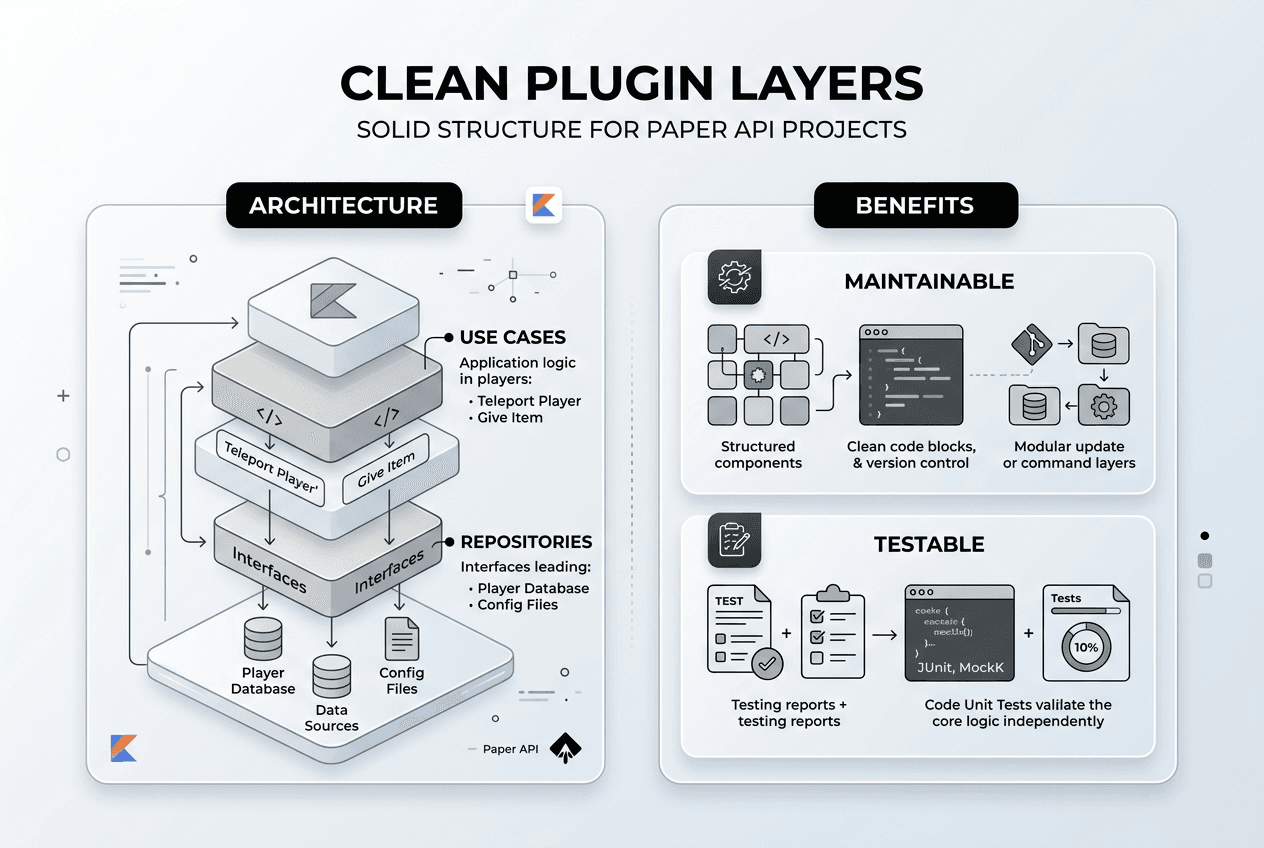
Repositories abstract data access, supporting multiple data sources transparently. Repositories handle data access and abstract data sources for better architecture separation. You can switch from file-based storage to database persistence without changing business logic. This flexibility becomes critical as server requirements evolve.
| Aspect | Traditional Architecture | Clean Architecture |
|---|---|---|
| Business logic location | Mixed with event handlers | Isolated in Use Cases |
| Data access | Direct file/database calls | Abstracted through Repositories |
| Testing difficulty | High coupling makes mocking hard | Clear boundaries enable easy testing |
| Dependency direction | Outward to frameworks | Inward to business rules |
| Change impact | Ripples through entire codebase | Contained within layers |
Plugins implementing SOLID principles have a 35% increase in adaptability and 25% fewer design-related bugs. These improvements stem from reduced coupling and clearer responsibility boundaries. When each component has a single, well-defined purpose, modifications become surgical rather than systemic.
Core SOLID principles for plugin development:
- Single Responsibility: Each class serves one clear purpose
- Open/Closed: Extend behavior through composition, not modification
- Liskov Substitution: Subtypes must fulfill parent contracts completely
- Interface Segregation: Create focused interfaces, not monolithic ones
- Dependency Inversion: Depend on abstractions, not concrete implementations
Pro Tip: Avoid over-engineering by applying Use Cases when project scale justifies benefits. Small plugins with three features don't need elaborate architecture. Start simple and refactor when complexity increases. The goal is maintainability, not architectural purity. If your architecture makes simple changes harder, you've over-engineered.
Leveraging Maven for clean dependency management and build processes
Maven manages dependencies, transitive dependencies, and version conflicts automatically. When you declare a dependency, Maven downloads it along with everything it needs. This automation prevents the "it works on my machine" problem. Maven's dependency management results in a 20% reduction in build times and fewer dependency issues. You spend less time configuring and more time developing.
Build lifecycle automation through Maven reduces manual error and accelerates deployment. Define your build process once in pom.xml, then execute it reliably across all environments. Maven handles compilation, testing, packaging, and deployment through standardized phases. This consistency eliminates environment-specific build failures.
| Process Aspect | Manual Management | Maven-Managed |
|---|---|---|
| Dependency resolution | Manual download and classpath setup | Automatic with transitive handling |
| Build time | 15-20 minutes with manual steps | 3-5 minutes automated |
| Version conflicts | Frequent runtime errors | Resolved during build |
| Team consistency | Varies by developer setup | Identical across all machines |
| Deployment reliability | Prone to human error | Repeatable and scripted |
Over 20 million artifacts in Maven Central simplify dependency resolution for Minecraft plugin developers. You access mature libraries without manual integration work. Maven Central's vast ecosystem means someone has likely solved your problem already. Leverage existing solutions instead of reinventing functionality.
Best practices for structuring Maven projects in Kotlin Paper API plugin development:
- Define explicit version properties for all dependencies
- Use dependency management sections to centralize versions
- Configure the Kotlin Maven plugin with appropriate JVM target
- Set up shade plugin to relocate conflicting dependencies
- Include Paper API as a provided scope dependency
- Configure resource filtering for plugin.yml generation
Pro Tip: Always define explicit dependency versions to avoid unexpected runtime errors. Relying on version ranges introduces unpredictability. A library update might break your plugin without warning. Lock versions in production, update deliberately after testing. This discipline prevents surprise failures during server restarts.
Discover quality Minecraft plugins and development resources
Building clean, maintainable plugins requires both solid principles and practical resources. You've learned architectural patterns and tooling strategies that separate professional plugins from amateur attempts. Now you need a trusted source for high-quality plugins and development tools.
Explore minecraft plugins & stuff built with clean code principles. Access development tools and resources designed to streamline your plugin creation process. Benefit from regular updates and community support tailored for Paper API and Kotlin developers. Each plugin demonstrates the clean architecture patterns discussed in this guide, giving you real-world examples to study and adapt.
Pro Tip: Integrate tested plugins from trusted sources to accelerate your server setup with confidence. Building everything from scratch wastes time on solved problems. Focus your development effort on unique features that differentiate your server. Use proven plugins for common functionality like permissions, economy, and chat management.
Frequently asked questions
What is clean code in the context of Minecraft plugins?
Clean code in plugins means writing clear, modular, and maintainable code that minimizes bugs and technical debt. It involves following best practices like SOLID principles, clear API definitions, and automated dependency management. Using tools like Maven and Kotlin's features can aid in maintaining clean, readable plugin code. The goal is creating systems that other developers can understand and modify without extensive documentation.
How does Maven improve plugin development for Paper API?
Maven automates builds and manages dependencies to prevent version conflicts and reduce errors. It speeds up development by providing a standardized, repeatable build process. Maven eliminates manual classpath configuration and ensures consistent builds across different developer machines. This automation reduces onboarding time for new team members and prevents environment-specific bugs.
What are Use Cases and Repositories in plugin architecture?
Use Cases encapsulate business logic, separating it from state and improving testability. Repositories manage data sources, abstracting data access and helping maintain clean architecture. This separation means you can change how data is stored without touching business rules. Use Cases represent player actions or system operations, making your code align with actual server behavior.
How can I avoid over-engineering my Minecraft plugins?
Start with simple implementations that solve immediate problems clearly. Refactor and add complexity only as needed to maintain readability and maintainability. Many developers create elaborate frameworks before understanding requirements, wasting effort on unused abstractions. Focus on delivering player value first, then optimize architecture when pain points emerge through actual use.
Why should I separate API and implementation modules?
Separating API and implementation modules ensures binary compatibility and allows other plugins to depend on stable interfaces. Your implementation can evolve without breaking dependent plugins. This separation also enforces good design by making you think carefully about public contracts. Changes to internal implementation don't require recompiling plugins that use your API.
What role does dependency injection play in clean plugins?
Dependency injection improves testability by allowing you to substitute mock implementations during testing. It reduces coupling between components, making each class easier to understand in isolation. Constructor injection makes dependencies explicit, documenting what each class needs to function. This clarity helps new developers understand component relationships quickly.